
How Much Protein Do You Really Need? (The RDA Is a Floor, Not a Target)
The 0.8 g/kg RDA was designed to prevent deficiency, not to optimize muscle. What the evidence actually supports, why it rises with age, and why it matters more on a GLP-1.
The number you've heard is 0.8 grams per kilogram of body weight per day. It appears on government websites, in nutrition textbooks, and in most articles on the subject.
It is not wrong. It is answering a different question than the one you're asking.
What the RDA was built to do
The Recommended Dietary Allowance is defined as the intake sufficient to meet the requirements of approximately 97.5% of healthy individuals. Read that carefully: it's a deficiency threshold, set deliberately above the average requirement so that nearly everyone is covered — a floor with a safety margin built in.
It was never intended to describe the intake at which muscle protein synthesis is maximized, body composition improves during weight loss, or age-related muscle loss is best resisted. Those are optimization questions. The RDA answers an adequacy question.
Using the RDA as a target is like treating the minimum oil level on a dipstick as the recommended fill.
There's also a methodological issue. The 0.8 g/kg figure derives largely from nitrogen balance studies — measuring nitrogen in versus nitrogen out and finding the point of equilibrium. The technique has known limitations: it tends to overestimate how much nitrogen the body retains (some losses, through skin and sweat, go unmeasured), which makes requirements look lower than they are, and short adaptation periods bias results downward further.
More recent work using indicator amino acid oxidation (IAAO) — which tracks the oxidation of a labeled amino acid to identify where the body stops treating protein as a limiting resource — consistently lands higher. IAAO studies in healthy young adults suggest requirements closer to 1.0–1.2 g/kg, roughly 30–50% above the RDA. In older adults, the estimates rise further.
The RDA hasn't been wrong for decades. It's been answering the wrong question for people who want more than the absence of deficiency.
What the evidence supports
Here's where the literature actually sits, by situation. All figures are grams per kilogram of body weight per day. To convert: divide your weight in pounds by 2.2.
| Situation | Evidence-supported intake |
|---|---|
| Sedentary adult, deficiency avoidance | 0.8 g/kg (the RDA) |
| Healthy adult, general health | 1.0–1.2 g/kg |
| Adult doing resistance training | 1.6 g/kg |
| Adult in a caloric deficit | 1.6–2.4 g/kg |
| Adult over 65 | 1.0–1.2 g/kg healthy; 1.2–1.5 g/kg if active, ill, or losing weight |
| On a GLP-1, losing weight | 1.6+ g/kg, deliberately planned |
The 1.6 figure has the cleanest evidence behind it. A large meta-analysis of resistance training studies identified a breakpoint at approximately 1.62 g/kg per day — beyond which additional protein produced little further gain in lean mass (the upper end of the statistical estimate was about 2.2 g/kg, which is why some people aim a bit higher). That's a plateau, not a "more is better" claim. Below it, you're leaving adaptation on the table. Above it, you're mostly buying expensive calories.
For a 180-pound (82 kg) person, that's about 130 g of protein daily. Many people who think they eat a high-protein diet land well short of that once they actually track it.
The over-65 numbers reflect a specific physiological change. Ageing muscle becomes less responsive to the anabolic signal from dietary protein — a phenomenon called anabolic resistance. The same 20 g of protein that produced a robust muscle protein synthesis response at 25 produces a blunted one at 70. You need more protein to achieve the same effect. The PROT-AGE expert group recommends 1.0–1.2 g/kg for healthy older adults, rising to 1.2–1.5 g/kg with acute or chronic illness.
Which produces an unfortunate irony: protein needs go up with age while appetite and intake go down. This is a major contributor to sarcopenia, and it's largely preventable.
Distribution matters, not just the total
A common pattern: coffee for breakfast, a modest lunch, and a large protein-heavy dinner. Same daily total as an evenly distributed intake — meaningfully worse outcome.
Muscle protein synthesis is triggered by a threshold, not simply by the amount. The trigger is largely leucine, and the response appears to require roughly 2.5–3 g of leucine in a single sitting, which corresponds to about 25–40 g of high-quality protein — or about 0.4 g/kg per meal.
Below the threshold, you get a diminished response. Far above it, the extra isn't wasted (it's still used for other purposes) but doesn't produce a proportionally larger synthesis response.
So the practical target is three to four meals containing 30–40 g of protein each, rather than one containing 100 g. This matters more with age, since anabolic resistance effectively raises the threshold.
The breakfast problem is the biggest single fix for most people. Typical Western breakfasts — cereal, toast, pastry, fruit, coffee — contain very little protein. That means a stretch of 12 to 16 hours overnight and into midday with no meaningful anabolic signal. Moving 30 g of protein into breakfast is often the highest-yield change available, and requires no increase in total calories.
Why this matters more if you're on a GLP-1
This deserves its own section, because it's where the stakes are highest and the gap between practice and best practice is widest.
In most weight-loss interventions, roughly a quarter to 40% of total weight lost is lean mass. Some of that is unavoidable and appropriate — a smaller body needs less structural tissue. But muscle is metabolically active, it's the largest site of glucose disposal in the body, and it's the tissue most tightly linked to independence, fall risk, and mortality in later decades.
GLP-1 and dual GIP/GLP-1 medications create a particular problem: they work by suppressing appetite. That's the therapeutic benefit. It also makes it genuinely difficult to eat enough protein, because protein-rich foods are filling and the medication has already reduced the drive to eat at all.
The result is a predictable failure mode: substantial weight loss on a low absolute protein intake, with a body composition change that looks worse than the scale suggests. You end up lighter and metabolically less capable — and if you eventually stop the medication and regain, the regained weight tends to be disproportionately fat.
If you're on one of these medications, protein is not optional and it will not happen by accident. Practical approach:
- Anchor protein to a schedule, not to hunger. Hunger is no longer a reliable prompt. Eat protein at set times.
- Protein first at every meal. Fullness arrives early, so eat the protein before anything else on the plate.
- Use liquid protein when solid food is unappealing. A whey or casein shake delivers 25–30 g with minimal volume and minimal GI burden. On nausea-heavy days this is often the only thing that works.
- Resistance train at least twice a week. Protein supplies the substrate; loading supplies the signal. Neither works well alone. This is the single most important non-negotiable in medical weight loss.
- Track for two weeks at the start. Not forever — just long enough to calibrate. Nearly everyone discovers they're eating substantially less protein than they estimated.
The kidney question
This comes up constantly, so let's settle it.
In people with healthy kidneys, higher protein intake has not been shown to cause kidney damage. Multiple systematic reviews and meta-analyses, including trials in resistance-trained individuals consuming well above 2 g/kg for extended periods, have found no adverse effect on glomerular filtration rate or markers of kidney function.
The confusion has a specific origin. In people with existing chronic kidney disease, protein restriction is a legitimate therapeutic intervention that slows progression. That's a genuine clinical finding — but it applies to damaged kidneys, and it was generalized into a warning for everyone. Restricting protein because someone with kidney disease benefits from it is like restricting salt because someone with heart failure benefits from it: correct for that patient, unfounded as general advice.
Where caution does apply: established chronic kidney disease, a single kidney, or a history of certain kidney stones. Those are conversations with a clinician who has your labs.
The other frequently cited concern — that high protein harms bone via acid load — has been examined and largely reversed. Higher protein intake is now generally associated with better bone mineral density and lower fracture risk, particularly with adequate calcium.
Where the protein comes from
Quality means two things: the amino acid profile (whether it supplies all essential amino acids in useful proportions) and digestibility. The modern metric is DIAAS, which improves on the older PDCAAS scoring.
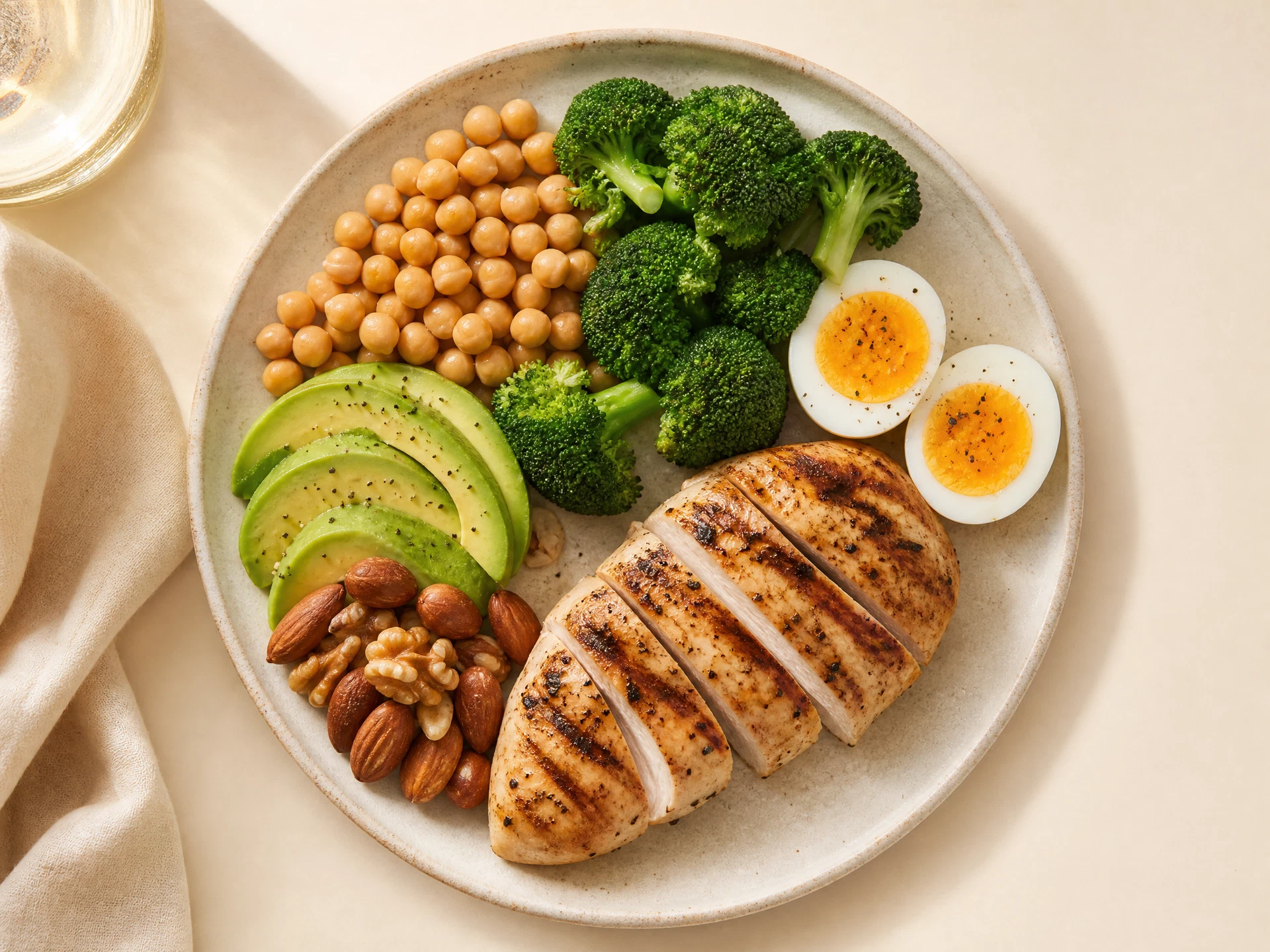
Animal proteins — whey, eggs, dairy, meat, fish — score highest. They're complete and leucine-rich, which matters for hitting the per-meal threshold.
Plant proteins are perfectly workable with two adjustments. Most are lower in one or more essential amino acids (grains tend to be low in lysine; legumes in methionine) and generally lower in leucine. So:
- Eat more of it. A reasonable rule is roughly 20–25% more total protein on a predominantly plant-based diet to compensate for digestibility and amino acid profile.
- Vary the sources across the day. The old "combine complementary proteins at every meal" advice was overstated — the body maintains an amino acid pool across hours — but variety across a day does matter.
Soy and pea protein score well and are leucine-adequate. Soy in particular is a complete protein comparable to animal sources for muscle protein synthesis.
Rough protein per typical serving:
| Food | Serving | Protein |
|---|---|---|
| Chicken breast | 4 oz cooked | ~35 g |
| Greek yogurt, plain | 1 cup | ~20 g |
| Whey protein | 1 scoop | ~25 g |
| Salmon | 4 oz | ~29 g |
| Eggs | 2 large | ~12 g |
| Cottage cheese | 1 cup | ~25 g |
| Lentils, cooked | 1 cup | ~18 g |
| Tofu, firm | 4 oz | ~20 g |
| Black beans, cooked | 1 cup | ~15 g |
The part nobody mentions: protein is filling
Two additional properties make higher protein useful during weight loss beyond muscle preservation.
Satiety. Protein is the most satiating macronutrient per calorie, through effects on ghrelin, GLP-1, peptide YY, and cholecystokinin. Higher-protein diets consistently produce lower spontaneous calorie intake in controlled trials — people simply eat less without trying.
Thermic effect. Roughly 20–30% of the calories in protein are expended digesting and metabolizing it, compared with 5–10% for carbohydrate and 0–3% for fat. Shifting a meaningful share of calories toward protein modestly increases total energy expenditure. It's not dramatic, and it's not nothing.
What to actually do
- Calculate your target. Body weight in pounds ÷ 2.2 = kilograms. Multiply by 1.6 if you train or you're losing weight; by 1.2 if you're generally sedentary and just want adequacy; by 1.0–1.2 if you're over 65 and healthy, or 1.2–1.5 if you're over 65 and active, ill, or losing weight. Or use our protein calculator, which applies these same numbers.
- Divide by four. That's your per-meal target, and for most adults it lands between 30 and 40 g.
- Fix breakfast first. It's where nearly everyone is short and where the change costs the least.
- Track for two weeks. Then stop. You'll know what 35 g looks like on a plate, and you won't need an app again.
- Lift something twice a week. Protein without loading builds far less than protein with it.
Why this belongs in a longevity conversation
Muscle is not a cosmetic asset. It's a reserve.
Skeletal muscle is the largest site of insulin-mediated glucose disposal in your body — more muscle means better glycemic control, which shows up in your fasting insulin and HOMA-IR. It's a reservoir of amino acids your body draws on during illness, injury, and surgery; people with more muscle recover better from serious medical events. And grip strength and muscle mass are among the more robust predictors of all-cause mortality in the epidemiological literature.
Muscle mass peaks somewhere around age 30 and then declines by roughly 3–8% per decade, accelerating after 60. The amount you carry into your seventies is largely determined by how much you build in your thirties and forties and how carefully you defend it in your fifties.
Protein is the substrate. Resistance training is the signal. Neither is optional, and this is one of the few areas of longevity where the evidence is unambiguous and the intervention is entirely within your control.
Frequently asked questions
Is 0.8 g/kg actually wrong? No — it's an accurate deficiency threshold. It just isn't an optimization target, and it's routinely presented as though it were.
Can I eat too much protein? For building muscle, the benefit plateaus around 1.6 g/kg (up to about 2.2 g/kg at the high end of the estimates). In a calorie deficit, intakes up to about 2.4 g/kg help preserve lean mass. Higher intakes haven't been shown to harm healthy kidneys, but they displace other calories.
Do I need protein right after training? The "anabolic window" was substantially overstated. Total daily intake and per-meal distribution matter far more than timing within an hour of a workout. Getting a proper protein meal within a few hours is plenty.
Are protein shakes necessary? No. They're convenient, and genuinely useful for people with suppressed appetite — including anyone on a GLP-1. Food works equally well if you can eat it.
Does protein help you lose weight? Indirectly and reliably: it's the most satiating macronutrient, it has the highest thermic effect, and it preserves the lean mass that keeps your metabolic rate up.
References
- Elango R, et al. Evidence that protein requirements have been significantly underestimated. Curr Opin Clin Nutr Metab Care. 2010. pubmed.ncbi.nlm.nih.gov
- Morton RW, et al. A systematic review, meta-analysis and meta-regression of the effect of protein supplementation on resistance training-induced gains in muscle mass and strength in healthy adults. Br J Sports Med. 2018. pubmed.ncbi.nlm.nih.gov
- Bauer J, et al. Evidence-based recommendations for optimal dietary protein intake in older people: a position paper from the PROT-AGE Study Group. J Am Med Dir Assoc. 2013. pubmed.ncbi.nlm.nih.gov
- Schoenfeld BJ, Aragon AA. How much protein can the body use in a single meal for muscle-building? Implications for daily protein distribution. J Int Soc Sports Nutr. 2018. pubmed.ncbi.nlm.nih.gov
- Jäger R, et al. International Society of Sports Nutrition position stand: protein and exercise. J Int Soc Sports Nutr. 2017. pubmed.ncbi.nlm.nih.gov
- Devries MC, et al. Changes in kidney function do not differ between healthy adults consuming higher- compared with lower- or normal-protein diets: a systematic review and meta-analysis. J Nutr. 2018. pubmed.ncbi.nlm.nih.gov
- Volpi E, Nazemi R, Fujita S. Muscle tissue changes with aging. Curr Opin Clin Nutr Metab Care. 2004. pubmed.ncbi.nlm.nih.gov
This article is educational and is not medical advice, a diagnosis, or a treatment recommendation. Protein recommendations differ for people with chronic kidney disease, liver disease, certain metabolic disorders, or during pregnancy. Talk with a licensed clinician or registered dietitian before making substantial dietary changes, particularly if you have an existing medical condition. Individual results vary.
Losing weight on a GLP-1?
Protein and resistance training decide how much of what you lose is fat. A Reserve clinician can build that into your plan.
Explore medical weight loss